Many have noted that the Bible’s Book of Jeremiah, in its present form, is NOT in chronological order. To properly understand the World and Words of the Prophet Jeremiah we must first determine the correct order and arrangement of the materials and THEN study the words, prophecies, and narratives. In this class we show that while the present order is confused, clues within the text allow us to rearrange things into a more sensible order. Thankfully, many of the narrative sections inform us where they fit chronologically into Jeremiah’s prophetic career. This class concerns the chronology and context of the Book of Jeremiah.
This series covers the World and Words of the Prophet Jeremiah. In this class we begin to sort out the events from the beginning. In order to do so we orient ourselves to the unfolding narratives contained in Jeremiah by providing the background to some of the characters mentioned in the book. We also uncover the time of the writing of Jeremiah’s original scroll from the narrative of the present-day book of Jeremiah. What do we know about the original Jeremiah Scroll? What happened to THAT scroll?
This series covers the World and Words of the Prophet Jeremiah. In class one, I introduce the new series and show multiple scribal hands in the Book of Jeremiah. I also shed light on Jeremiah’s village of Anathoth. We learn in the superscription that Jeremiah is of the priests in Anathoth in the land of Benjamin. What do we know about Anathoth? Quite a bit, actually.
Jews and Christians believe that Moses wrote the Torah. Scriptural evidence supports this view. According to the texts of the Hebrew Bible, the Torah that Moses wrote is referred to by several phrases: Sefer ha-Torah, Sefer Moshe, Torat Moshe, Sefer torat Moshe, and torat Moshe avdi. This class works through each of these, establishing that per the Hebrew Bible’s texts, Moses did, in fact, write the Torah, but what did THAT Torah consist of? What is the Torah that Moses wrote? Is it the Pentateuch – the five books traditionally ascribed to Moses (Genesis, Exodus, Leviticus, Numbers, and Deuteronomy)?
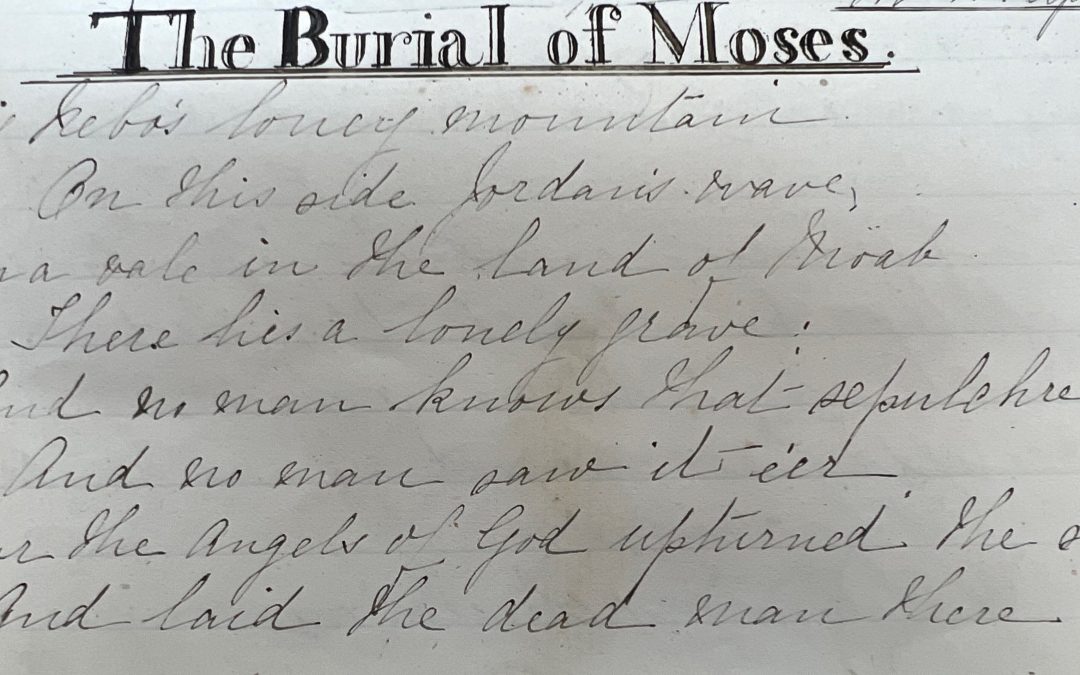
In 1875, Cecil Francis Alexander penned a poem called The Burial of Moses. The opening stanza says
By Nebo’s lonely mountain
On this side Jordan’s wave
In a Vale in the land of Moab
There lies a lonely grave
And no man knows that sepulcher
And no man saw it e’er
For the angels of God upturned the sod
And laid the dead man there
In this class, we take a careful look at the texts related to Moses’s death and burial. Did Moses write about his death and burial? Did Joshua write this section? Do the texts provide clues as to where these events take place? Did Moses die on the mountain or in the valley?
A HORIZONTAL STUDY OF FIVE MONTHS IN THE 40TH YEAR
Many fail to recognize the intended chronology recorded in the Pentateuch. This is only appreciated when we carefully study the narratives and align the parallel passages. In this study, I show the following:
The time and place of Aaron’s death and burial (and prove that the geographical references place this event WEST of the Jordan rift and not east as most suggest).
Israel didn’t cross the rift until the 40th year.
The battles with the Canaanite King of Arad, Sihon, and Og take place between the 6th month and the 11th month of the 40th year.
Toward the end of this same period, Balak hires Balaam, the incident at Baal Peor, the defeat of the Midianites (in the land of Moab), the commissioning of Joshua, and the writing of THE Torah all take place.
After the day of assembly at Horeb, the people were so afraid that they would die if they heard the voice again that they requested Moses to convey God’s words. In response to this request, God said that he would raise up a prophet like Moses. Is this a promise of a singular prophet figure or a series of prophets? In this class, we review the words of Deuteronomy 18 to seek an answer to this debate. We also discover a phrase used by all God’s true prophets.
After the giving of the Ten Words, the narratives contained in Exodus and Deuteronomy inform us that the witnesses to this event were terrified. They were so fearful that they suggested an alternative to hearing the voice of God directly. They suggested that Moses go to God and hear the message, and then he (Moses) would pass the message to them so they wouldn’t die. The narratives of Exodus and Deuteronomy agree up to this point. But from this point forward, the stories depart. Exodus, written in the third person, reports what the author knows (Exodus 20:21). Moses “drew near unto the thick darkness where God was.” The story in Exodus ends there because the writer does not know what exchange took place in that thick darkness. Only Moses would know and be able to report on that. And so, the first-person account in Deuteronomy, presented as the words of Moses, fills in the details. It has to be this way. Watch this class to see why and to learn what happened in the Thick Darkness.
Three subjects dominate biblical religion: sacrifices, the temple, and the monarchy. No one can deny the central place each of these plays in the narratives of the Bible. And yet, for the past 2,000 years, all who seek to follow or claim to follow “biblical religion” have been without all three. The absence of these elements leads to questions. Were sacrifices needed? Are they needed now? Does God desire them? What about the temple? Is a temple needed? Did God ask for a temple? What about the monarchy? Did God desire a monarchy for Israel? Is the “torah of the king (Deuteronomy 17:14-20)” authentic to the Torah? Was this written in the time of Moses? A careful study of the biblical texts reveals some surprising and challenging answers.
This teaching is part of a year-long study of the Pentateuch called, The Pentateuch: A New Look.
*Storms disrupted the video feed of this class. but the audio was recorded without interruption. It is available below and also as a podcast. Find United Israel on Apple Podcasts, Spotify, Amazon Music, Stitcher, iHeart Radio, Pandora, and just about every other podcast platform.
Torah portion Re-eh (11:26-16:17) begins with Moses describing a ceremony that will take place after the children of Israel cross the Jordan into the land promised to them by YHVH, but this narrative is interrupted by fifteen chapters of legal material (chapters 12-26). These chapters are referred to as the law code. After a brief explanation of the material contained in Deuteronomy’s law code, the focus of the teaching is shifted to cover some key points from Deuteronomy, namely, what does YHVH ask of you? Beginning with Deuteronomy 10:12-22, we work through several texts that show some of Deuteronomy’s unique phrases. The class begins to illustrate that Deuteronomy presents a form of pure ethical monotheism that only appears in the fifth book of the Pentateuch.
Due to technical issues with our internet, the video feed was interrupted. These will be edited later. The audio of this class has already been edited and is available here.
Exodus 32-34 and Deuteronomy 9-10 provide the material for a class comparing and contrasting the Bible’s narrative of the second set of stone tablets. The first set, seen only by Moses, was destroyed. What do we [think we] know about the second set of stone tablets? Who made the first set? Who made the second set? Who wrote on the first set? Second set? Answers to these questions and more in this class. Here is a link to the document used in this class.
Parsha Va-Etchannan (and I pleaded) arguably contains some of the most important words in all Scripture. It contains a version of The Ten Words, often referred to as The Ten Commandments. These words were reportedly spoken by God to the children of Israel at Horeb/Sinai from the midst of fire and later written on two stone tablets. But what were those words? We have two accounts, one in Exodus chapter twenty and one in Deuteronomy chapter five, and they disagree. Sure, the differences are relatively minor, but why are there any differences? Why would the versions of such important words not be exact? The version of Deuteronomy informs the reader that there are ten sayings, but there are disagreements as to how to count them. What precisely were the words spoken by God and later written on two stone tablets? Do either of the accounts (Exodus 20 or Deuteronomy 5) accurately present the words of the covenant, or do neither of the accounts? How are we to decide? According to the biblical narratives, only Moses saw the two stone tablets (he shattered them). How will we ever put the pieces of this mystery together? “The Bible’s Two Versions of The Ten Commandments” begins the search for the original words.