One of the themes of the Passover season is the resurrection of the dead. What is the resurrection of the dead, and what does the Hebrew Bible say about life beyond the grave? This teaching provides an overview of the subject. It also covers related material from the Tanakh including eternal life, the question of the immortality of the soul, and what the bible says happens when we die.
Food and diet play a major role in the Hebrew Bible, beginning in the Garden of Eden. In this class, we discuss the biblical diets with a focus on the laws of Leviticus chapter eleven and Deuteronomy chapter fourteen. After covering some basic regulations and restrictions, the texts of Leviticus eleven and Deuteronomy fourteen are compared and contrasted in a horizontal study.
The meaning, cause, and remedy of the biblical צרעת have been the source of much debate. Traditional translations have rendered the word as leprosy, usually with the somewhat confusing caveat that despite the retention of leprosy, it does not mean leprosy. The root צרע yields our problematic צרעת , proper names, and three occurrences of a stinging insect capable of chasing out Hivites, Canaanites, Hittites, and two Amorite kings! Shapira’s MSS sensibly suggests a more dangerous fiend to the Canaanites than a hornet-the dreaded צרעת.
And YHVH shall be King over all the earth; in that day shall YHVH be One, and His Name One. (Zech. 14:9)
There’s an old saying that when the elderly die, a library is lost, and volumes of wisdom and knowledge are gone. Could such be the case with Moses? It has been approximately 3,400 years since the event at the burning bush where YHVH appears to Moses and tells him, firsthand, His Name. Since that time, the Torah that was given to the Israelites has witnessed countless wars, destruction, exile, and malicious alignment by the “lying pen of the scribes (Jer. 8:8)” as well as editing, redacting, and mistranslating by our more modern translators. The tablets that the Ten Commandments are inscribed upon, the Ark of the Covenant, and the Moses Scroll appear to have vanished – at least for now.
What we have today in the form of the Hebrew Bible is due to the tireless efforts of the Masoretes, a group of Jewish scholars who worked in Palestine and Babylon between 6-7 A.D. When copying scrolls, the Masoretes were required to follow strict rules defined in the Talmud: A synagogue roll had to be written on skins of clean animals prepared by a synagogue Jew, only authentic copies were to be recopied, and nothing was to be written based solely on memory. Viewing the text as Sacred, they were reluctant to use vowel pointing. Their method has been proven to be quite accurate due to their meticulous care, and the Masoretic text became universally accepted as the authentic Hebrew Bible.
Preserved in these texts are the Four Hebrew Letters of God’s Name: יְהוָֹה (YHVH/YHWH). It is found nearly 7,000 in the Hebrew Bible, with the most common pronunciations being “Jehovah/Yehovah” and “Yahweh”. What was not preserved, however, is the exact pronunciation and meaning of this most important Hebrew Name. Countless volumes have been written by Hebrew scholars, Sacred Name groups, occultists – you name it (no pun intended), and debates still continue in an effort to come to a solid conclusion, with some of them carrying on the tradition of demonizing those who don’t agree with their theories.
Being what I consider to be an open-minded critical thinker (like most folks in our movement), I have studied the various explanations of YHVH’s Name and meaning; however, I cannot wholeheartedly commit to any one view as being the ultimate, definitive pronunciation and meaning of The Name. I am sure that many of you reading this find themselves in the same situation. As a result, when addressing YHVH in prayer, I sometimes use the ancient El Elyon(Most High God), or more frequently, Almighty. Sometimes I don’t use any words, I simply visualize the Four Letters while praying. Many of my Jewish friends use Adonai (LORD, or Master, or HaShem (The Name).
Here I would like to offer another possibility for consideration. Recently, my studies about hesed (YHVH’s constant mercy and lovingkindness) led me to also research this Hebrew word’s sister – ahava, which means “love”. BTW, I had always thought the similarity between the sound of Yehovah and ahava to be a bit uncanny, but the consonants are different – YHVH uses a “vav” and ahava uses a “veht”. Some scholars explain that this could be a phonetic variant.
Taking a close Iook at Exodus 3:14, when Moses asks God what His Name is, God first answers by saying, אֶהְיֶה אֲשֶׁר אֶהְיֶה (ehyeh asher ehyeh, or I Am what I Am) and then He commands Moses to “tell them Ehyeh sent me unto you.” But afterward there appears to be a switch. In verse 15 God then tells Moses to say to the Israelites:
“YHVH, the God of your fathers, the God of Abraham, the God of Isaac, and the God of Jacob, hath sent me unto you. This is My Name for ever, and this is My memorial unto all generations.” (Exodus 3:15)
The word ehyeh (I am) contains three of the four letters of the Tetragrammaton (one letter is used twice) and even sounds similar to the pronunciation Yahweh, but it seems as if ehyeh is almost being forced upon the word YHVH. Also worth noting – the shoresh (root word) for Ehyeh is HYH, while the root word for YHVH is HVH.
In 1956 a Hebrew and Arabic a scholar Shelomo Dov Goitein (1900-1985) suggested that the Name YHWH is actually a Proto-Arabic word, derived from the root HWY – hawaya, which means “love, affection, passion, desire.”
Goitein also suggests, as a possible connection, that in Exodus 34:14 the phrase “YHWH whose name is Jealous” is wrongly translated, and that the word קַנָּא qanna (Jealous) is derived from the Arabic term for passion and really means “The Impassioned One”.
He translates this verse as such:
“For you must not worship any other god, because YHWH, whose Name is Impassioned, is an Impassioned God.” (Exodus 34:14)
Goitein also gives a possible translation of ehyeh asher ehyeh as: “I shall passionately love whom I love”.
We know that Moses dwelt in the house of Jethro the Midianite, tended Jethro’s flocks, and married a Midianite woman. Goitein gives the following reasons for the word being Arabic:
The Midianites were a Proto-Arabian tribe living in Arabia and they are related to the Ishmaelites;
Midian was nearby or contiguous with Seir, and was a Nomad-land called Yehwa, yhwꜣ(w);
In the Hebrew Bible, YHWH Comes from the Edomite South (Deut. 33:2); (Judg. 5:4); (Hab. 3:3).
In reference to the Land of Yehwa: in antiquity, names were sometimes used as a toponym(place name) as well as a theonym (the name of a god). An example is the name Assyria (Assur); it is both the name of Assyria’s chief deity and of their ancient capital city.
Another proponent of this theory is Prof. Israel Knohl, the Yehezkel Kaufmann Professor of Bible at the Hebrew University of Jerusalem and a senior research fellow at the Shalom Hartman Institute. In his article on Torah.com, Knohl touches on many of Goitein’s points, adding:
“If YHWH’s origins are in the Nomad-land of Yehwa among the Midianites, then the meaning of the name should be from the Arabic language family rather than the Hebrew language family. This further calls into question the etymology in Exodus 3 of the Tetragrammaton from ה.ו.י, “to be,” since, unlike Hebrew and Aramaic, Proto-Arabic does not have the root ה.ו.י for the word “to be.””
While there were other gods whose names expressed the meaning of love (Er-s), the Name YHVH is exceptional in that it denotes action – love (v), exclusiveness, loyalty, and monotheism.
Why is this important? Whether you call upon YHVH using the Name Yahweh, Yehovah, or perhaps even Yahava – what really matters is that we have carefully thought and talked about the importance of The Name. In the Book of Malachi we read that YHVH is listening and taking note of our exchanges, recording them in a Sefer Zikaron (Book of Remembrance):
“Then they that feared YHVH spoke one with another; and YHVH hearkened, and heard, and a book of remembrance was written before Him, for them that feared YHVH, and that thought upon His Name. (Malachi 3:16)
In closing: The Great Commandment instructs us to: “Shema (hear) Israel: YHVH our God, YHVH is One. And you shalt love אָהַבְתָּ (ahavta) YHVH thy God with all thy heart, and with all thy soul, and with all thy might.” Passionately!
Patty Tyler is an independent researcher and a member of the Board of Directors for United Israel World Union. She and her husband David direct the United Israel Center Northeast in Upstate New York.
GOITEN, Shelomo Dov: “YHWH the Passionate: The Monotheistic Meaning and Origin of the Name YHWH,” Vetus Testamentum 6.1 (1956): 1-9. (Contact me for a copy of this paper at: PTyler@aac-usa.com.)
This class is based on material found in Leviticus 8, 9, and 10. In chapter eight, Aaron and his sons are consecrated for their role as priests. This involves an anointing ceremony from which all later “messiah” studies must be based. In the Pentateuch, only the priest was anointed and therefore referred to as hacohen hamashiach. Aaron and his sons were Moses’ messiahS. Chapter nine details a reported manifestation of the Kavod YHVH (Glory of YHVH). Chapter ten reports the killing of two of Aaron’s sons. What led to their death?
In our current day and throughout history, in church sermons, Bible classes, and Biblical literature, we hear about YHVH’s punishments, curses, and retributions being meted out on the Israelites for disobeying Him and breaking His commandments. It appears, however, that we have forgotten or neglected to see the “other side of the coin” – the seemingly endless Biblical accounts of YHVH’s immense love, mercy and kindness that He has shown to his children and the promises of such in the future. Have we been so consumed with fear and concerned with being litigiously correct that we have overlooked this most amazing aspect of our Creator, known in Hebrew as hesed?
It is tempting for me to say that hesed may be the most important word in the Bible. The Jewish Sages go as far as to say, “Olam Hesed Yibaneh” – The world is created by hesed. The Hebrew word “hesed” (חֶסֶד, pronounced kheh’-sed), found 248 times in the Tanakh, describes an essential attribute of the Character of YHVH. This word is difficult to translate into English, resulting in a myriad of meanings employed throughout the many translations of the Bible. The most commonly used definitions include mercy, steadfastness, lovingkindness, unfailing love, and faithful love, among others. These translations, however, barely skim the surface of the rich, multilayered meaning that underlies this word. Some Hebrew scholars say that hesed is more than just a description of feeling; that it also denotes action. Others say, and we shall see, that the Biblical texts attest to the fact that not only is YHVH’s hesed sometimes undeserved or in excess, it also appears to be unconditional. Like a parent who disciplines their child but doesn’t stop loving or showing kindness to him/her, YHVH’s hesed toward backsliding Israel was constant and unwavering.
In Exodus 34:6–7, one of the most often quoted verses of the Bible, YHVH appears to Moses to give him the second copy of the Law and describes Himself as “merciful and gracious, long-suffering, and abundant in goodness (hesed) and truth, keeping mercy (hesed) for a thousand generations to those who love Him and keep His commandments.” This was after the people sinned with the molten calf. As we shall see, this is no ordinary love. Of course, the remainder of the verse tells us that the breaking of YHVH’s covenants and laws have dire consequences – but does this mean that YHVH will remove His hesed? God forbid!
Consider the prophet Isaiah:
“In a little wrath I hid My face from thee for a moment; but with everlasting kindness (hesed) will I have compassion on thee, saith YHVH thy Redeemer.” (Isaiah 54:8) And:
“Though the mountains be shaken, and the hills be removed, yet my unfailing love (hesed) for you will not be shaken.” (Isaiah 54:10)
In Jeremiah:
“YHVH appeared to him from afar, saying, “I have loved you with an everlasting love; Therefore, I have drawn you with lovingkindness (hesed).” (Jeremiah 31:3)
In YHVH’s promise to King David and his offspring we read that though He will punish them for their iniquities, His hesed appears to be unconditional.
“For ever will I keep for him My mercy (hesed), and My covenant shall stand fast with him.” (Psalm 89:29) And:
“If his children forsake My law and walk not in Mine ordinances; If they profane My statutes, and keep not My commandments; Then will I visit their transgression with the rod, and their iniquity with strokes. But My mercy (hesed) will I not break off from him, nor will I be false to My faithfulness. (Psalm 89:31-34)
The theme of eternal hesed for the House of David continues in 2 Samuel and Psalm 136:
“A tower of salvation is He to His king; and showeth mercy (hesed) to His anointed, to David and to his seed, for evermore.” (2 Samuel 22:51)
In Psalm 136, also known as the Great Hallel, the word hesed is used 26 times. Most likely this Psalm was sung “antiphonally”, i.e. the cantor would sing the first line of each verse and the choir would respond with the refrain: kiy l’olam hesedo (His faithful love, or mercy endures forever, literally “for unto eternity is His hesed”). By the way, in gematria the number 26 is the sum of the Hebrew characters יהוה (YHVH).
In contrast, in the following verse regarding David and King Saul, YHVH’s hesed toward David is unconditional, as opposed to that dealing with Saul. Some scholars say this verse is referring to the throne of Saul rather than hesed. Perhaps Saul had refused to accept YHVH’s hesed, or the “covenant of hesed” had not been established with King David yet.
“If he commit iniquity, I will chasten him with the rod of men, and with the stripes of the children of men: But my mercy (hesed) shall not depart away from him, as I took it from Saul, whom I put away before thee.” (2 Samuel 7:14-15)
Some other examples of YHVH showing hesed to His servants: Nehemiah uses the word in his brief prayer when restoring proper Sabbath observance:
“And I commanded the Levites that they should purify themselves, and that they should come and keep the gates, to sanctify the Sabbath day. Remember unto me, O my God, this also, and spare me according to the greatness of Thy mercy (hesed).” (Nehemiah. 13:22)
The Book of Ruth is a story of hesed. Ruth showed unwavering love and loyalty to Naomi, Boaz showed hesedby marrying Ruth in order to give Elimelech an heir, and Naomi testifies to YHVH’s hesed in Ruth 2:20 by acknowledging His hand in bringing Ruth to Boaz: “Blessed be he of YHVH, who hath not left off His kindness (hesed) to the living and to the dead.”
Throughout the New Testament the Greek word used to describe YHVH’s mercy, pity, kindness, and compassion is ἔλεος, eleos, (pronounced el’-eh-os); however, Shem Tob’s Hebrew Gospel of Matthew uses the Hebrew word hesed:
“Go and learn that which is written: I desire kindness (hesed) and not sacrifice;” (Matthew 9:13, HGM)
“If you had known what this is: I desire kindness (hesed) and not (sacrifice), you would not have convicted the innocent.” (Matthew 12:7 HGM)
“When they came out, he saw behind him a numerous people; so he extended kindness (hesed) to [them] and healed all of their diseases.” (Matthew 14:14 HGM)
“Woe to them, the sages and Pharisees, who tithe (mint,) dill, and pomegranate, but who commit robbery (and leave undone) that which is weightier, that is, the judgments of the Torah which are: kindness (hesed), truth and faithfulness. These are commands worthy of doing; one should not forget them.” (Matthew 23:23 HGM)
The question remains: how do we, as mere mortals, practice hesed? In Judaism, a person who embodies hesed is known as a Hasid (חסיד) – one who is faithful to the covenant and who goes “above and beyond that which is normally required”. Hosea tells us that hesed is something that YHVH desires: “For I desire mercy (hesed), and not sacrifice, and the knowledge of God rather than burnt-offerings.” (Hosea 6:6) In Micah 6:8 we are told that it is a requirement: “It hath been told thee, O man, what is good, and what YHVH doth require of thee: only to do justly, and to love mercy (hesed), and to walk humbly with thy God.” Zechariah 7:9 teaches us that hesed is not above our comprehension; it is not a trait solely of the divine, but it is imbedded in each and every one of us, as children made in the image of God: “Thus hath YHVH Sabbaoth spoken, saying: ‘Execute true judgment, and show mercy (hesed) and compassion every man to his brother…’”
There are many examples of the display of hesed being shown between people throughout the Hebrew Bible; too many to list here. David shows hesed to King Saul when he was close enough to kill him but spares his life. He also shows kindness (hesed) to Hanun the son of Nahash in 2 Samuel Chapter 10. In 1 Kings 2:7 David instructs Solomon to “dohesed” (show kindness) unto the sons of Barzillai the Gileadite. In Proverbs, the Virtuous Woman “opens her mouth with wisdom; and the law of kindness (hesed) is on her tongue”.
In the New Testament’s Sermon on the Mount, the Jewish teacher Jesus gives a step-by-step “tutorial” on the unconditional and the “going above and beyond” aspects of hesed:
“Ye have heard that it hath been said, An eye for an eye, and a tooth for a tooth: But I say unto you, That ye resist not evil: but whosoever shall smite thee on thy right cheek, turn to him the other also. And if any man will sue thee at the law, and take away thy coat, let him have thy cloke also. And whosoever shall compel thee to go a mile, go with him twain. Give to him that asketh thee, and from him that would borrow of thee turn not thou away.”
“Ye have heard that it hath been said, Thou shalt love thy neighbor, and hate thine enemy. But I say unto you, Love your enemies, bless them that curse you, do good to them that hate you, and pray for them which despitefully use you, and persecute you; That ye may be the children of your Father which is in heaven: for he maketh his sun to rise on the evil and on the good, and sendeth rain on the just and on the unjust. For if ye love them which love you, what reward have ye? do not even the publicans the same? And if ye salute your brethren only, what do ye more than others? do not even the publicans so? Be ye therefore perfect, even as your Father which is in heaven is perfect.” (Matthew 5:38-48)
In conclusion: James the brother of Jesus once said, “faith, if it hath not works, is dead, being alone”. Perhaps the same can be said about Torah faith…if it hath not hesed.
Patty Tyler is an independent researcher and a member of the Board of Directors for United Israel World Union. She and her husband David direct the United Israel Center Northeast in Upstate New York.
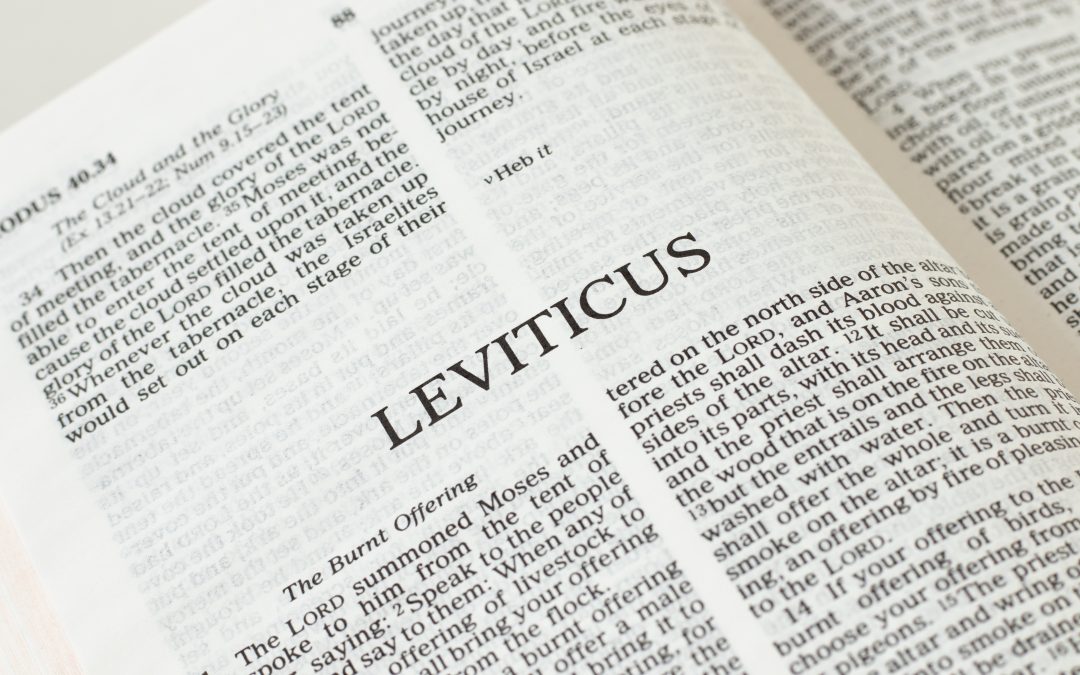
This is the opening class of the Book of Leviticus. The introduction provides some chronological framework for the Bible’s third book as well as basic information about the contents. The first seven chapters cover a series of types of sacrifices. According to Leviticus, expiation is tied to the sacrificial cult. Repentance alone, per Leviticus, is not enough. The book contains no mention of mercy, grace, or kindness. Sacrifice is the means whereby a person can draw near to God. What then are we to do without sacrifices? Does God need, want, or desire our sacrifices? Is blood required? These questions and more are answered in this class on sacrifice and offering.
Of course, we know there is no “DSS Bible” per se, but 40% of the scrolls are from Hebrew Bible texts–but they have significantly different readings, some of which agree with the Greek Septuagint (LXX) and the Samaritan Pentateuch. If you go to the site the live presentation will begin streaming. If you don’t see it refresh your browser. I have chosen what I consider the most fascinating half-dozen examples. You will be amazed.
Ezekiel ben Buzi, the priest and prophet described two “visions of God” in chapters one and ten. In these chapters, he attempts to describe what he saw using a series of similes. The two “visions” are one and the same. What was it that appeared to Ezekiel? And how do these visions relate to the Chest of the Testimony? This teaching also traces the movement of the chest from Horeb/Sinai, over more than 800 years of history, covering the stories and locations central to the various narratives that describe it.
There is more on the Tabernacle than any subject in the Pentateuch, and the central piece of furniture within this holy tent is the chest that was constructed to contain the two tablets of the Testimony or Covenant. What do we know about the making of the chest? Who made it? What was it made of? What was kept inside the chest? In part one of a two-part teaching on the Chest of the Testimony, these questions and more are answered.
The Pentateuch contains two accounts of the sin of the molten calf. The basic story told in both books, says that during Moses’ forty-day stay in the mountain to receive the two stone tablets, the people make a molten calf. God told Moses what they had done and instructed him to go down, further threatening to wipe them out and start over with Moses. When Moses sees the corruption of the people, he throws the two stone tablets to the ground, breaking them. He then burns the image and throws the dust and ashes in the water. God then commands Moses to cut two new stone tablets and to bring them back up the mountain. The “Ten Commandments” are written on the second set of stone tablets. Each account provides details that are lacking in the other version. The purpose of this study is to recognize the similarities and differences between these two accounts.
In this teaching, Dr. James Tabor discusses the significance of the Hebrew word עדת – Eduth. The word is used to describe an important object, mentioned numerous times in the Pentateuch. Tabor carefully builds his case by working through the texts to answer the question – what is the Testimony?



 And YHVH shall be King over all the earth; in that day shall YHVH be One, and His Name One. (Zech. 14:9)