In this week’s class, Ross shares a message about keeping the commandments. He begins with some texts that say we should keep commandments. He also shows that according to these passages, keeping the commandments leads to a holy life. Some say that it is impossible to keep all the commandments. Some say it is not. In this informative teaching, Ross talks about keeping the commandments that we can keep. He further challenges us to check our motivations.
Watch on YouTube
Watch on Facebook
Click to Download John “Baruch” Perry’s Class Notes
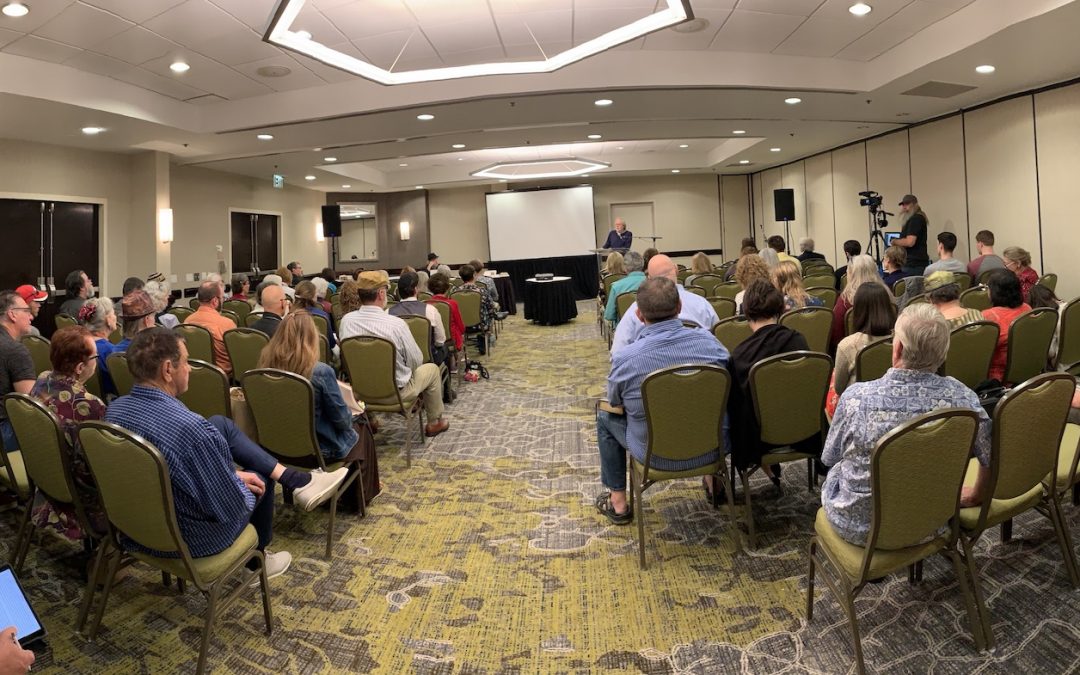
As the month of April came to a close, more than one hundred friends converged on Charlotte, North Carolina for the 76th Annual Meeting / Conference of United Israel World Union, Inc. The meeting was held as in years past at the Hilton DoubleTree in Southpark, a fitting place to host an organization dedicated to the reunion of the two sticks (see Ezekiel 37). Eight presenters gave talks on a variety of subjects over the course of the weekend gathering. In this blog post, the links to these talks are provided as well as a link to the class notes provided by our friend and “scribe” John “Baruch” Perry. The YouTube videos are arranged in the order in which they were delivered.
Outside the Gates of Eden: The Ultimate Human Purpose – Dr. James D Tabor
Lasting Legacy – A Case for the Book of David – Ralph Buntyn
Finding the Hand of Moses: THE Torah Within OUR Torah – Ross K Nichols
Essence of Hebrew Faith – Advice for Living Day to Day According to the Scriptures – David Tyler
Antisemitism Then and Now – Paul Weinberg
I Have Not Spoke in Secret – Jodell Onstott
Moses and Passionate Love – Barry Page
John “Baruch” Perry’s Class Notes From Conference Talks
The Scriptures provide several examples of those who are described as having walked with God. What does the Bible mean by this phrase? By looking closely at these stories we are able to determine what is meant by walking with God. True Biblical faith is described by this walk and we should therefore study the subject in order to learn to walk in the faith.
In this class, Ross shares a teaching on the Festival season of Passover / Unleavened Bread. He demonstrates that the events commemorated during this time are of central importance in the Bible, seeking to show that the events arguably make up the greatest story ever told. Not only do they represent the beginning of Israel as the people of God, but through these events, God “makes a name for Himself.” And yet, it has rarely been kept “as written.” Bringing together texts from the Torah, Prophets, and Writings, he shows that within the Bible we can find a template for restoration based upon “keeping” this festival, even if we are not keeping it as written. And if the pattern discerned in the texts is accurate, it may still work!
Most people don’t want others telling them what they should or shouldn’t eat. And yet, many of us don’t eat enough of what is good for us, and we eat too much of what is not good for us. Our foods have additives and are missing key nutrients. We often eat what pleases our eyes, or what we believe makes us seem wise. Many of us are unhealthy and unhappy. Hunger and malnutrition are global issues. All of the above is about our spiritual diets. #notbybreadalone#food4famine
In this week’s teaching, Ross continues his series on Theophany. In this class he focuses on a manifestation of YHVH that according to Scripture was manifested to the entire nation of Israel, not just once but rather for the duration of the wilderness journeyings. Further, Ross shows that this manifestation is prophesied to take place again.
In this week’s teaching, Ross begins to explore some of the mysteries of the Hebrew Bible, particularly those texts which describe human encounters with the Divine. Can man see God? Maimonides, in his, The Guide of the Perplexed says that these are not to be taken literally, that they are describing an “intellectual apprehension.” The Christian Scriptures state clearly that no one can see God (John 1:18, 5:37, 6:46; I Timothy 6:16; I John 4:12). The Hebrew Bible has God Himself say, “No man can see My face and live.” And yet, despite these beliefs and supportive texts, the Bible also contains anthropomorphic texts, and passages which seem to present human encounters with God. In this introductory class, Ross begins to explore these mysterious matters.
In this teaching Ross discusses the subject of Torah in the Heart. Following his three previous classes on the New Covenant of Jeremiah, Ross takes a closer look at the internalization of the Torah of Jehovah, mentioned in Jeremiah’s New Covenant Oracle. What will be the signs of one having the Torah in the Heart? Ross seeks to show from Scripture that the plan has truly never changed. What’s in your heart?
In this teaching, Ross brings to light the exciting contents of an ancient scroll contained within the present Book of Jeremiah. This scroll speaks of a virgin, of God’s son, of one dying for sins, the forgiveness of sins, the return of God’s son and MORE. This is a follow up teaching to – A New Covenant – Part One
In this class, Ross begins to explore the subject of a New Covenant. The phrase, “New Covenant” is mentioned only once in the Hebrew Bible. It is recorded in Jeremiah 31:31-34 (30-33 in Hebrew). These four verses, 92 words in the original Hebrew, contain all that specifically mentions a new covenant. The goal of this series is to seek to understand all that we can about the New Covenant mentioned in the Book of Jeremiah.
Following his two previous classes (Thoughts-Torah from the Inside and Two Tablets-On Stone and Flesh), Ross continues to look at the idea that internalization of YHVH’s ways is and always has been necessary. In this week’s lesson, based in part on the words of Deuteronomy 29:4, Ross shows that this internalization was prophesied in the words of a covenant – besides the covenant of Sinai.
In this teaching, Ross shares a message about the event Moses describes as this great thing – the revelation of YHVH at Sinai and the giving of the Testimony, or Ten Words. He covers the event as recorded in Scripture and shows that this Testimony is unique and clearly identified as being the work of God, written on two tablets of stone, placed in a special box, which is then placed in a tent. Ross goes on to show that the Testimony was never intended to to be engraved on stone tablets to remain forever there, but rather was intended to be internalized – to first guard these words and then to share.